

Harder does not mean better: the intensity problem in Hardcore and Hard Techno
Harder kicks. Faster BPM. More distortion. Bigger drops. This is the language of modern hard dance music, and for a while it felt like the only language that mattered. But harder does not mean better, and the longer the scene pretends otherwise, the more every release starts to sound like the one before it.
Hardcore, Uptempo and Hard Techno have never been afraid of intensity. Physical pressure is part of their identity. These styles were not built to sit quietly in the background. They were built to move bodies, overload sound systems and create an atmosphere that more polite forms of electronic music tend to avoid. None of that is the problem.
The problem is what happens when intensity becomes the only measure of quality. When every kick has to be more distorted than the last, every drop has to feel more destructive, and every track has to win a fight with whatever came out the week before. At some point you have to ask the uncomfortable question: when everything is extreme, does anything still feel extreme?
Hard music was never just about loudness
Hardcore and Hard Techno are physically powerful genres, but their power has never come from loudness alone. The impact of a track is built from rhythm, sound design, arrangement, tension, contrast, groove, atmosphere and the context it is played in. A distorted kick can make a track feel aggressive. A fast tempo can create urgency. A huge drop can flip the energy of a room. But not one of those things automatically makes a track memorable.
The most effective hard music is not a pile of extreme sounds stacked on top of each other. It is a controlled system where every element pushes the same idea. That is also why there is a real difference between a track that is technically loud and a track that is genuinely powerful. Loudness can raise perceived impact for a few seconds. It cannot invent character where there is none.
This is exactly the trap the industry already walked into once. The loudness war pushed records louder and louder until dynamic range was crushed and everything started to fatigue the ear. Audio engineer Matt Mayfield explained the whole thing in under two minutes, and it is still the clearest demonstration of why louder is not the same as better.
Loud is a technical characteristic. Power is an artistic result. The two get confused constantly, and hard music is where that confusion does the most damage.
The intensity competition
Hard dance music has always evolved by pushing boundaries. Hardcore pushed the tempo and aggression of rave music. Industrial styles brought harsher textures and a more confrontational mood. Uptempo accelerated the rhythmic experience even further. Modern Hard Techno absorbed pieces of Hardcore, schranz, industrial, rave and hard dance until the borders basically dissolved. That evolution is healthy. It is the culture doing what it is supposed to do.
The trouble starts when evolution turns into a permanent competition, where every new release is expected to deliver a more aggressive kick, a faster perceived energy, a more explosive drop, a harsher distortion chain and a louder master than the one before it. Artists stop competing to make good records and start competing to manufacture the next most extreme moment.
That creates a loop that eats itself. One artist raises the intensity. Everybody else copies the sound. The new sound becomes normal. The scene demands something even more extreme. Contrast disappears. What once sounded brutal becomes standard, what once felt unusual becomes expected, and what once defined a subgenre becomes another preset. If that sounds familiar, it is the same mechanism we wrote about in Is the Scene Eating Itself?, only measured in decibels instead of ideas.
BPM is not a personality
Tempo is one of the most visible traits of hard dance music. Hardcore Techno usually lives around 160 to 190 BPM, and Uptempo variants push well beyond that depending on the artist and the scene. Melodigging's overview of the style describes it through exactly these terms, fast tempos, distorted kicks, abrasive sound design and relentless rhythmic drive. You can read their breakdown of Hardcore Techno and Hard Techno for a clear picture of the technical foundations.
Those characteristics matter. But BPM is not an artistic identity by itself. A track at 180 is not automatically more exciting than a track at 160. A track at 200 is not automatically more innovative than one at 175. Tempo changes the physical relationship between the music and the body. It changes rhythmic density, the speed of the movement and how transitions land. It does not answer the questions that actually decide whether a track survives.
What does this track want to say? What makes this artist different from the next one? What emotional world does the music build? Why should anyone remember it after the drop is over? If the only answer is "because it is faster," the idea probably was not strong enough to begin with. BPM can amplify an idea. It cannot replace one.
The kick arms race
The kick is the centre of Hardcore, Uptempo and Hard Techno. It carries the pulse, the weight and a huge part of the genre's identity. In many tracks it is not simply a drum. It is a bass instrument, a tonal element and the main sound design statement all at once. Modern production stacks a sharp transient, a heavy body, a distorted tail, saturation, clipping, harmonic enhancement and careful low end control into a single sound.
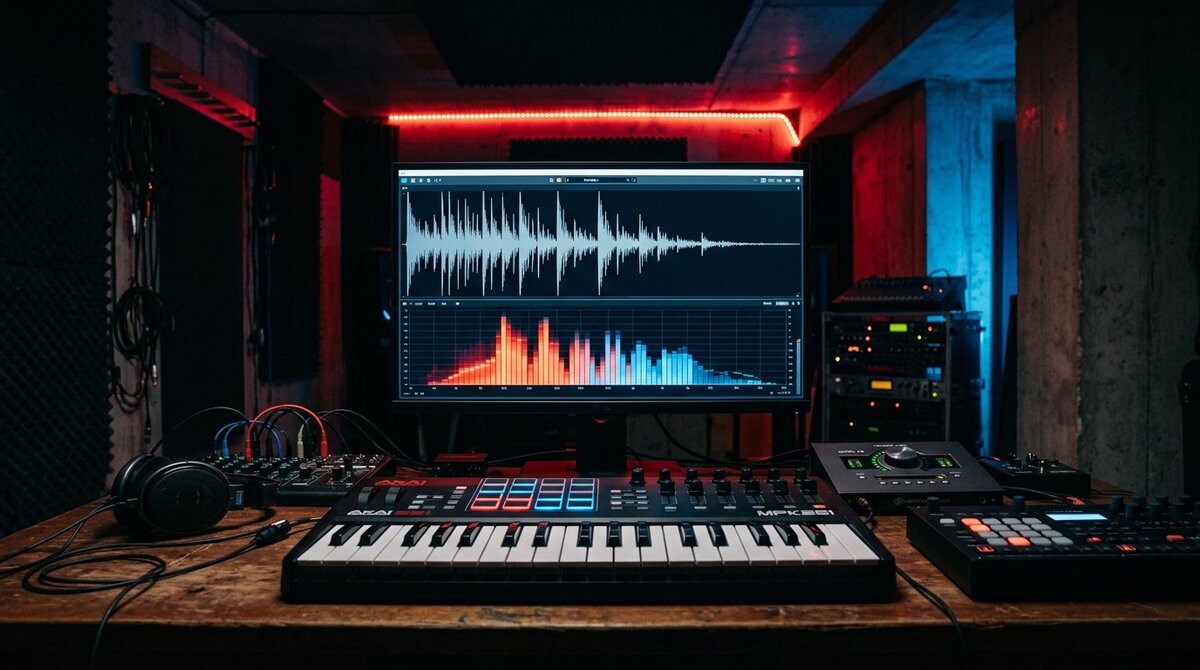
None of that is a problem. Distortion is part of the language and always has been. The problem shows up when every track uses distortion the same way, with the same frequency emphasis, the same arrangement logic and the same expectation of impact. At that point the kick stops working as an artistic signature and becomes a box to tick.
The scene starts asking "is this kick harder than the last one?" instead of asking "does this kick belong to this track?" Those are completely different creative standards, and only one of them produces music people remember.
When distortion stops creating impact
Distortion creates harmonics. It makes a sound feel denser, rougher and more present. It helps a kick translate on smaller speakers and adds character to an otherwise clean signal. But distortion also reduces separation. If every element is saturated, clipped or overdriven, the mix loses its hierarchy. The kick might be louder, yet the listener no longer understands what makes it special.
The same thing happens at the arrangement level. If every section runs full kick pressure, maximum distortion, constant vocal impact, dense percussion, huge risers and repeated fake outs, the track has no meaningful contrast. The listener cannot feel the difference between tension and release because there is no real reduction in energy anywhere. A track does not get more powerful by holding maximum intensity for its entire length. Most of the time it gets smaller.
A track does not become more powerful by staying at maximum intensity. It becomes exhausting, and exhausting is easy to forget.
Every drop is becoming a final boss
One of the most common habits in modern hard music is trying to make every single drop feel like the defining moment of the track. The intro builds. The tension rises. The vocal arrives. The effects pile up. The kick returns. Then the track promises the exact same emotional payoff several more times before it ends.
When every drop is designed to be the biggest moment, the listener adapts almost instantly. The brain gets familiar with the level of impact and the shock disappears. A drop works because something was withheld before it, whether that is the kick, the sub, the main percussion, the full stereo image, the lead vocal or the dominant distortion. Without a reduction there is no real return. Without space or restraint there is no explosion. A drop only feels massive when the track built somewhere to fall from.
This is the same short attention economy pulling on the music that we described in Your Crowd Is Killing the Scene. When tracks are built to survive as fifteen second clips, they stop being built to survive as records.
Hard music needs contrast, not softness
Saying hard music needs contrast is not the same as arguing it should get softer. Hardcore does not need to become house. Uptempo does not need to slow down. Hard Techno does not need to drop its industrial pressure. The point is different. Aggression becomes more effective when it has structure around it.
A brutal section becomes more brutal when it follows a moment of restraint. A distorted kick becomes more distinctive when it is not surrounded by ten equally distorted elements. A fast section feels faster after a slower or more open passage. A vocal becomes more memorable when the arrangement leaves it room to breathe. Contrast is not a compromise. It is a weapon, and it matters most in club music, where the crowd lives inside the track physically for several minutes. Constant pressure creates fatigue. Controlled variation extends attention and makes the key moments hit.
The difference between brutality and noise
There is a difference between a track that is aggressive and a track that is simply overloaded. Aggression has direction. Noise has no hierarchy. A powerful track makes it clear what the listener should focus on, which element carries the groove, where the tension is heading, when the energy is about to shift and which sound represents the artist. An overloaded track makes everything fight at once. The kick is distorted, the bass is distorted, the vocal is distorted, the lead is distorted, the effects are distorted and the master is clipped on top.
It can sound impressive for a few seconds in isolation. Over a full track or a full DJ set, the lack of hierarchy becomes exhausting. This is why technique carries so much weight in hard music. As Your Ghost Production point out in their guide to everything you need to know about Hard Techno, the genre is not simply "loud techno." Rhythm, arrangement, sound design and control matter just as much as raw pressure. The intensity only works when the listener can actually read it. That gap between technical mastery and pure spectacle is the same tension we broke down in The Cost of Silence.
When the formula becomes the genre
Every scene builds recognisable formulas, and formulas are not automatically bad. They give artists a shared vocabulary. They help producers understand what works on a club system. They create common ground between artists, DJs and listeners. The problem appears when the formula stops being a foundation and becomes the entire composition.

Picture the standard build. A familiar kick pattern, a predictable vocal phrase, a tension build, a short silence, a heavy drop, a second drop with a slightly different kick, a final drop with extra distortion. It works. But when thousands of tracks run the same logic, the differences between them get more and more superficial. The kick changes a little. The vocal changes. The distortion chain changes. The artwork changes. The fundamental experience stays identical.
That is where the scene starts confusing recognition with identity. A track can sound immediately correct for a genre while offering almost nothing that belongs specifically to the artist who made it. This is the exact quantity over identity problem we mapped out in The Hard Dilemma.
Identity was always bigger than impact
Hardcore has always been tied to powerful kicks, high tempos and aggressive production. But the culture was never built on sound pressure alone. Its identity came from distinctive local scenes, labels with a strong visual and musical direction, dedicated communities, an unmistakable vocal language, fashion and subcultural codes, event culture, ritual and shared history. That combination let different artists and movements sound connected without sounding identical. The kick mattered, but the kick was never the whole culture.
Hardcore's strongest periods were not defined only by how distorted the productions were. They were defined by a recognisable worldview. That is the real difference between making a track that fits a genre and making a track that expands it. And in 2026, when anyone can download the same sample packs and chase the same loudness targets, identity is the one thing that cannot be copied. We argued the same point about producers themselves in The Death of the DJ-Producer.
What producers should ask instead
Instead of asking whether a track is hard enough, producers should ask sharper questions.
Does the track have a clear centre?
Can the listener identify the main idea after one play? That centre can be a kick, a rhythm, a vocal, a synth motif, a texture, an atmosphere or a structural idea. The track does not need a huge melody. It needs a clear reason to exist.
Is the distortion doing creative work?
Distortion should not be added simply because the genre expects it. Ask what it contributes. More harmonic presence? More aggression? More movement? More tension? More character? Better translation on small speakers? If the only answer is "it sounds louder," the processing is probably not serving the composition.
Is there enough contrast?
Listen to the track at a low volume, then listen to the arrangement with the master chain bypassed. Can you still feel the tension, release and movement? If every section feels equally intense, the track probably needs less information, not more.
Does the track survive outside the drop?
A memorable record should not depend entirely on one moment. The intro, breakdown, transition and groove all have to contribute. If the only interesting part is the drop, the track is behaving more like a content clip than a complete composition.
Could another artist have made it?
This is the uncomfortable one. If you removed the artist name, would the track still reveal who made it? If the answer is no, the production might be technically effective but artistically interchangeable.
The importance of space in a hard mix
Space is badly misunderstood in harder electronic music. A lot of producers assume that leaving room in a mix makes the track feel weaker. In reality, space makes the important elements feel bigger. A cleaner arrangement improves kick definition, low end translation, percussion clarity, vocal intelligibility, stereo depth and drop impact, and it reduces listener fatigue.
This does not mean every mix should be polished in a conventional sense. Rawness is part of many hard styles and should stay that way. But rawness and clutter are not the same thing. A raw mix can be intentional, physical and textured. A cluttered mix just contains too much competition. Anyone working with hard kicks and heavy distortion should watch low end overlap and upper mid harshness in particular. Samplesound's article on loudness, dynamics and club readiness is useful context for why impact cannot be reduced to a single integrated volume number.
If you want the deep technical side of this, controlling those peaks without destroying the master is the entire subject of our guide to Clip to Zero for electronic music. The goal is never to make the track polite. The goal is to make every aggressive decision readable.
Club pressure is not the same as streaming loudness
Hard music is made for physical spaces, but it also lives on headphones, phones, cars, DJ systems and streaming platforms. A master that sounds impressive in a short preview can become tiring across a full listen. A heavily clipped track can look louder while losing transient definition. A dense low end can work on one system and fall apart on another.
That does not mean there is one universal loudness target for Hardcore or Hard Techno. There is no single number that replaces listening, context and judgement. A club system brings its own scale, acoustics and physical pressure. The producer's job is to deliver a track with enough energy, clarity and headroom to translate properly. So the question should not be "how loud can I make this?" A better question is "how much intensity can this track sustain before the listener stops feeling the difference?"
The scene does not need less energy
None of this is an argument against aggression. It is not against distorted kicks. It is not against 180, 190 or faster. It is not against festival sized drops, brutal sound systems or extreme performances. Hardcore, Uptempo and Hard Techno should stay physical, uncompromising and confrontational. The scene just has to resist the idea that intensity only moves in one direction.
More distortion is not always more character. More BPM is not always more movement. More volume is not always more impact. More drops are not always more memorable. The future of hard music will not be decided by whoever makes the loudest track. It will be decided by whoever builds the strongest identity inside an increasingly crowded sonic environment.
Harder is a tool, not a creative direction
"Harder" can describe a sound. It should not be the entire artistic brief. A real creative direction needs more information. Harder in what way? Darker or more euphoric? More industrial or more rave driven? More hypnotic or more explosive? More mechanical or more emotional? More minimal or more chaotic? More functional or more cinematic? That is where identity begins.
Two artists can both make fast, distorted music and still build completely different worlds. One leans on mechanical repetition. Another builds a cinematic atmosphere. One uses harshness as a rhythmic tool. Another uses it as a psychological texture. The difference is not necessarily technical complexity. The difference is intention.
A better definition of progress
Progress in Hardcore and Hard Techno should not be measured only by rising intensity. Progress can also mean better arrangement, more distinctive sound design, stronger atmosphere, more useful DJ structures, more interesting tension, more effective dynamics, more personal vocals, a more original visual language and a more meaningful connection with the audience. A scene can get more advanced without getting constantly more aggressive. Maturity might be the ability to control aggression rather than just increase it. The best producers already know that restraint is not the opposite of hardness. Restraint is what gives hardness its shape.
Are we evolving or just turning up the noise?
Hardcore, Uptempo and Hard Techno are powerful because they create an experience that is immediate, physical and emotionally intense. That should never be diluted. But the scene has to be careful not to shrink its entire creative vocabulary down to speed, distortion and loudness. When every kick is trying to be the hardest kick, every drop is trying to be the biggest drop and every track is trying to sound more extreme than the last, the result becomes predictable.
The solution is not to make hard music softer. The solution is to make it more intentional. Use the kick as a signature, not a requirement. Use distortion as texture, not decoration. Use BPM to serve movement, not to prove intensity. Use silence to make the return matter. Use arrangement to build anticipation. Use aggression to express identity. Because the hardest track in the room is not always the one people remember. The future of hard music belongs to the artists who understand that impact is not the same as excess.
Think your next track has that identity? That is exactly what we listen for. Send us your demo.
Frequently asked questions
Does harder music automatically mean better music?
No. A harder sound can raise physical impact, but quality also depends on identity, rhythm, arrangement, contrast, sound design and emotional direction. Loudness is a technical trait. Power is an artistic result.
Is high BPM a problem in Hardcore or Uptempo?
No. High BPM is a core part of many Hardcore and Uptempo styles. The issue is treating BPM as proof of creativity instead of using it as one tool inside a bigger artistic idea.
Does distortion make a track more powerful?
Distortion can add harmonics, aggression and character. Too much of it reduces clarity and removes contrast. Its effectiveness depends entirely on how deliberately it is used.
Why do some loud tracks feel smaller than quieter tracks?
A track that holds constant maximum intensity creates listener fatigue and loses contrast. A track with controlled dynamics can make its most powerful moments feel far larger.
Does hard music need melodic elements?
Not necessarily. A hard track can be highly effective with minimal melody, but it still needs a clear identity. That identity can come from rhythm, texture, atmosphere, vocals or arrangement.
How can producers make a hard track more original?
Develop a personal kick design, use distortion in a distinctive way, build more intentional arrangements, create stronger atmospheres and avoid copying the same drop structure everyone else uses.
Should Hardcore and Hard Techno producers master their tracks quietly?
There is no single universal loudness value that works for every track or context. Prioritise translation, clarity, controlled dynamics and the intended use of the music rather than chasing a number.