

Clip to Zero for Electronic Music: How to Get More Loudness Without Destroying Your Master

In genres like Techno, Hardcore, and Uptempo, loudness matters — but crushing a track with a limiter is not the same as mastering it well.
A practical guide to controlling transients, gaining loudness, and keeping punch in aggressive electronic masters.
1. What "Clip to Zero" Actually Means
Clip to Zero is a mixing and mastering approach based on one core idea: instead of forcing a limiter to control every peak in your track, you intentionally reduce the most aggressive transients earlier in the chain using clipping.
In digital audio, 0 dBFS is the maximum available ceiling. Once a signal tries to go beyond it, the waveform is cut. That cut creates distortion. The important part is that not all distortion is accidental, and not all clipping is bad. In modern electronic music, clipping can be used deliberately as a technical tool to control peaks and increase perceived loudness.
The reason this matters is simple: many transient peaks — especially in kicks, claps, and percussion-heavy material — consume a lot of headroom without contributing the same amount of perceived loudness. If you control those peaks intelligently, the rest of the track can come forward more efficiently.

2. Why This Technique Works So Well in Electronic Music
Clip to Zero is especially effective in electronic genres because these styles rely heavily on short, aggressive transients. A Hardcore kick, an Uptempo snare, a distorted clap, or a sharp synth stab can create huge peak energy in a very short moment.
Those peaks dominate the available headroom. If you leave them unmanaged, your limiter has to work harder later, and that usually leads to a flatter, more fatiguing result. Instead of sounding more powerful, the track often becomes smaller, softer, and more strained.
That is why producers in harder electronic genres often use clipping not only as a corrective tool, but as part of the sound itself. Done properly, it helps the track feel more direct, dense, and controlled.
The key is not to destroy every transient. The goal is to decide which peaks are useful and which ones are just wasting space.
3. Clipping Is Not One Thing
A common mistake is to talk about clipping as if it were only one process. In practice, producers usually deal with at least three different peak-control behaviors:
- Hard clipping: fast, aggressive, and direct peak removal
- Soft clipping: more rounded, more colored, and often more musical
- True peak limiting: final output protection for delivery
Hard clipping is useful when you want to shave transient spikes with precision. Soft clipping is useful when you want to round the signal while adding harmonic density. A true peak limiter is the final safety stage that ensures your export behaves correctly on playback systems and distribution platforms.
These are not interchangeable. Each one has a different role in the chain.

4. The Basic Clip to Zero Chain
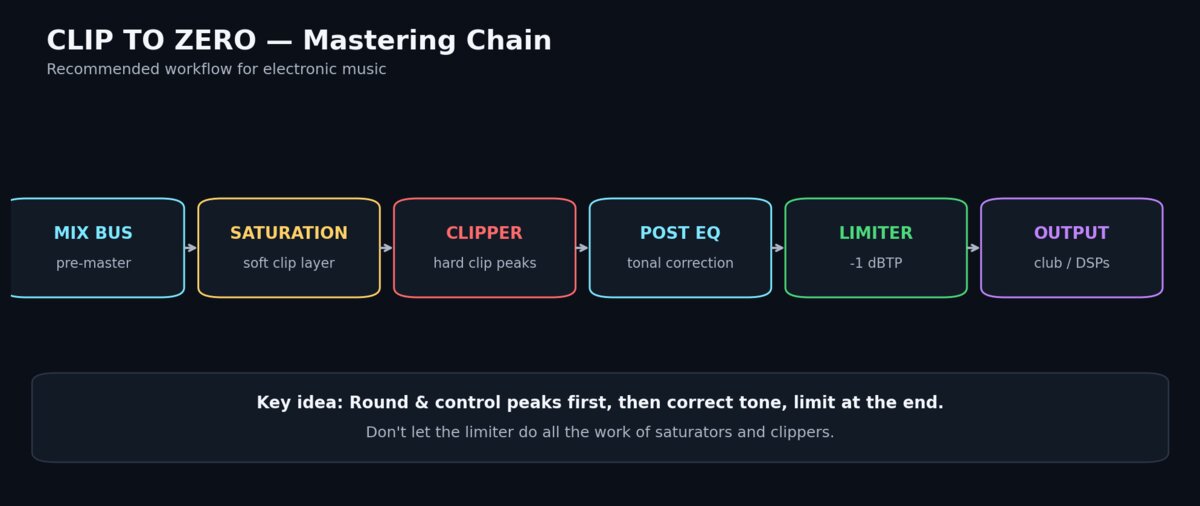
A practical Clip to Zero chain for electronic music can be extremely simple:
Mix Bus → Saturation → Clipper → Post EQ → Limiter → Output
Each stage has a reason to exist.
Mix Bus
Your mix should already be balanced before mastering starts. If the mix is collapsing, clipping will not fix it.
Saturation
A saturation stage can add harmonics and gently round peaks before harder peak control happens. This often helps the clipping stage sound smoother and more musical.
Clipper
This is where the main transient shaving happens. The clipper removes fast peaks that would otherwise force the limiter to work too hard.
Post EQ
After clipping, the tonal balance may shift slightly. Some harshness may appear in the highs or upper mids. A corrective EQ stage helps rebalance the result.
Limiter
The limiter is the final control stage, not the main loudness strategy. Its job is to catch what is left and hold the final ceiling cleanly.
Output
At this point, the master should feel louder, denser, and more controlled — without sounding crushed for no reason.
5. The Biggest Mistake Producers Make
The most common error is trying to get all the loudness from the limiter alone.
When a limiter is forced to do too much, several things usually happen:
- The kick loses impact
- The groove gets flatter
- The high end becomes tiring
- The master feels smaller even if the meter says it is louder
This is one of the main reasons amateur masters often sound "loud but weak." The level is there, but the physical sensation is gone.
Clip to Zero solves this by distributing the work across several stages instead of asking one tool to do everything.
6. Loudness Targets for Hardcore and Uptempo
In very aggressive genres like Hardcore and Uptempo, producers often chase extreme loudness numbers. But there is a practical point where pushing further stops being useful.
For clubs, getting the master above roughly -4 LUFS is often already enough. Beyond that, more processing does not automatically mean more impact. The club sound system, amplifier behavior, room acoustics, and PA tuning will contribute much of the physical energy that the audience feels.
That means overprocessing the master in search of more loudness can actually backfire. You may end up sacrificing clarity, punch, and translation just to gain a number that the venue system would have made irrelevant anyway.
For streaming delivery, the same high-quality WAV can often be used as long as the master is technically controlled and translates well. The important point is not to destroy the record chasing unnecessary loudness.

7. When Clip to Zero Goes Wrong
Like any aggressive technique, Clip to Zero can be abused.
It usually goes wrong when:
- The mix is not ready
- The kick is already too distorted before mastering
- Too much clipping is stacked without listening carefully
- The limiter is still being pushed too hard after clipping
- The producer is chasing meter numbers instead of translation
The point of this technique is not to make every track brutally loud. The point is to create a master that feels solid, intentional, and efficient.
If the clipping destroys the groove, blunts the kick, or makes the high end unbearable, the process has gone too far.
8. Final Takeaway
Clip to Zero is not about breaking the rules. It is about understanding where your headroom is being wasted and controlling it with intention.
For electronic music, especially harder styles, this approach can make the difference between a master that sounds flat and one that sounds confident, dense, and club-ready.
Used properly, clipping is not the opposite of dynamics. It is one of the tools that helps preserve impact where it matters most.
The goal is simple:
- Remove useless peaks
- Keep useful energy
- Let the limiter finish the job, not carry the whole master
That is where competitive loudness starts to sound professional.
Ready to Master Better?
If you produce electronic music and want louder masters without killing your transients, Clip to Zero is a technique worth understanding deeply.
At Magistrates, we care about records that hit hard and translate properly.