
Why do artists quit? The structural burnout in electronic music
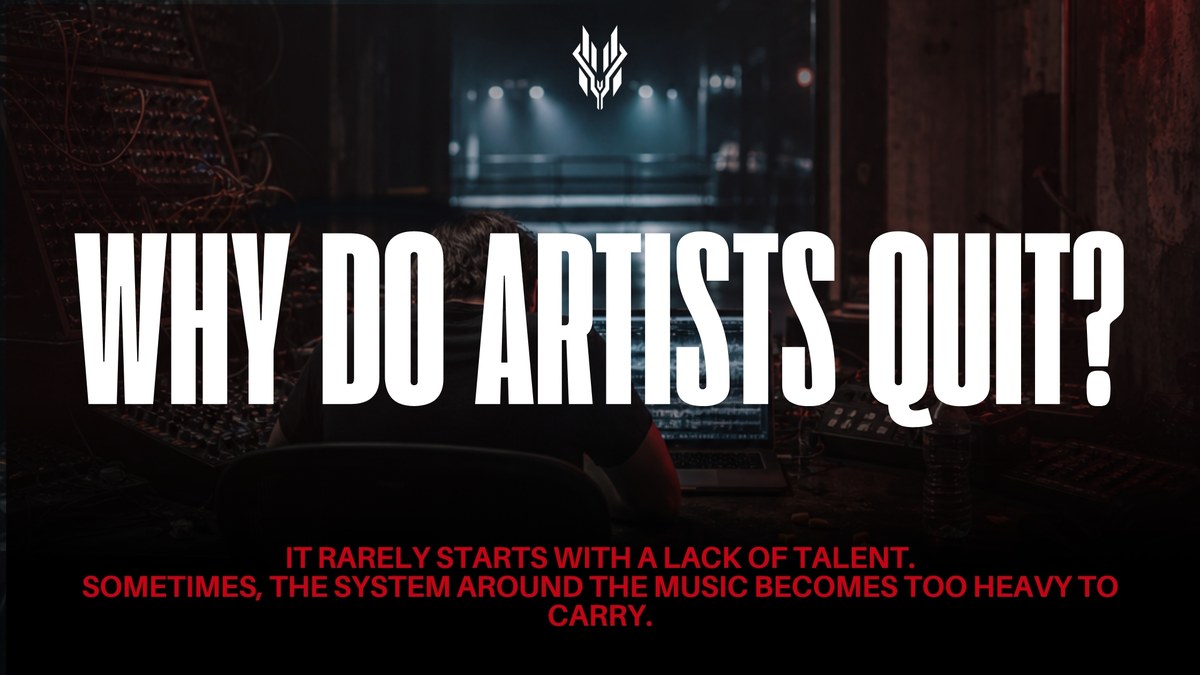
Most artists do not quit with a dramatic announcement. There is rarely a farewell post, a final release or a public goodbye. They simply go quiet. The uploads slow down. The studio sessions become shorter and rarer. One day you realise a producer you followed for years has not released anything in eighteen months, and nobody noticed the exact moment they stopped. The departure is silent, and that silence is the whole problem.
We like to tell ourselves a comforting story about why people leave music. They ran out of talent. They were not good enough. They did not want it badly enough. It is a convenient explanation because it protects the system and blames the individual. But after years of working with artists across Hardcore, Uptempo, Frenchcore and the wider electronic underground, we see a different pattern. The people who quit are very often talented, driven and genuinely in love with the music. They do not leave because the music got too hard. They leave because everything around the music got too heavy to carry.
This article is not a motivational speech, and it is not a list of wellness tips you have read a hundred times. It is an honest look at the structural reasons artists burn out in 2026, and what a label can actually do about it. If you make music and you have felt the exhaustion creeping in, this is for you.
The silent departure
Burnout in music almost never looks like a breakdown. It looks like avoidance. It looks like opening your DAW, staring at an empty project for twenty minutes and closing it again. It looks like dread every time a release date approaches. It looks like feeling nothing when a track you spent weeks on finally comes out.
Researchers who study this describe burnout as three things happening at once: chronic exhaustion that sleep does not fix, growing cynicism toward the work you used to love, and a quiet sense that nothing you do actually matters. That is not laziness. That is a nervous system that has been running at full output for too long with no recovery built in.
And it is widespread. The pressure on independent artists to be constantly visible, constantly productive and constantly "on" has turned a creative passion into a job that never clocks out. When the joy that pulled you in gets buried under obligation, the exit does not feel like giving up. It feels like relief. That is the most dangerous part.
The producer bandwidth split
From craft to a hundred jobs at once
There was a time when a producer could mostly be a producer. Someone else handled distribution. Someone else handled promotion. Someone else handled the business. That world is gone for the vast majority of independent artists. Today the expectation is that one person will write, arrange, mix and master the music, then design the artwork, cut the video clips, run the socials, plan the content calendar, write the captions, pitch the playlists, handle the distribution, answer the messages, negotiate the bookings and track the numbers.
Each of those tasks is a real job. Asking one person to do all of them, well, forever, is not a career. It is a slow overload. The skill that made the artist worth following in the first place, the music, ends up squeezed into whatever time is left after all the other roles have been served.
This is the friction almost nobody talks about. It is not that artists cannot make music. It is that they barely get to. The creative act becomes the smallest slice of the week, and the most joyful part of the work becomes the part that keeps getting postponed. Over months and years, that quietly erodes the reason a person started at all.
If you want a clear breakdown of how many separate skills the modern producer is expected to master, the industry writers at CD Baby have written directly about why musicians quit, and the picture they paint matches what we see every week.
Metric fixation and algorithmic anxiety
Here is a scenario that plays out constantly. An artist finishes a track they truly believe in. They release it. Within a few hours they are refreshing the streaming dashboard. The numbers are lower than they hoped. By the next morning the disappointment has curdled into something worse: the feeling that the music itself was not good enough, because the metric said so.
This is algorithmic anxiety, and it is corrosive. When your sense of worth is tied to a number that updates every hour, you hand your emotional stability to a system that was never designed to protect it. The algorithm does not care about your artistic development. It rewards frequency and consistency of output, so the pressure becomes: release more, post more, never stop feeding the machine.
The result is a treadmill. Artists chase the next release before they have recovered from the last one, not because the music is ready but because the gap in the numbers feels dangerous. The 2025 wellness research across the music industry repeatedly points to constant content demands as one of the leading contributors to poor mental health among artists. Being your own product, your own marketer and your own audience analyst at the same time is exhausting in a way that has nothing to do with how much you love music.
We wrote before about the trap of chasing guaranteed numbers in the 50 euro Spotify promo trap, and the same psychology drives burnout. When the number becomes the goal, the music becomes a means to an end, and that is the exact moment the passion starts to die.
The financial deficit equation
Passion can carry an artist a long way. It cannot pay rent indefinitely. One of the most honest conversations we can have about attrition is the money conversation, because financial precarity is one of the strongest predictors of burnout severity.
The maths is brutal for many independent producers. The income from streaming is small and unpredictable. The cost of equipment, software, samples, promotion and time is constant. Recoupment on releases can take a long time, and many artists do not fully understand where their money goes or when it comes back. We broke that down in detail in our guide on royalties and recoupment, because a career you do not understand financially is a career you cannot plan around.
When the deficit runs for years, something has to give. Usually it is the music, because the day job that actually pays the bills cannot be dropped. The artist does not consciously decide to quit. Reality just slowly makes the choice for them. This is why treating music as a sustainable long term practice, rather than an all in gamble, matters so much. An artist who can afford to keep going is an artist who is still around in five years.
Sustainable consistency versus reckless velocity
There is a myth that the way to make it is to flood the market. Release every week. Post every day. Never let the audience forget you exist. It sounds like discipline. In practice it is often the fastest route to collapse.
Speed for its own sake produces two problems. First, the quality drops, because nothing has time to breathe or to be finished properly. Second, the artist drops, because that pace is physically and mentally impossible to hold for years. Reckless velocity looks impressive for a season and then the person behind it disappears.
Sustainable consistency is the opposite philosophy. It means setting a release rhythm you can actually maintain on your worst month, not your best. It means batching the boring work so it does not invade every day. It means treating rest as part of the process rather than a reward you never allow yourself. A producer who releases four strong tracks a year for a decade will build far more than one who releases forty in a year and then vanishes.
Two ways to run a career
The burnout loop
Release fast → chase the numbers → panic at the dip → release faster → skip rest → lose the joy → go silent.
The sustainable pipeline
Plan a realistic rhythm → protect studio time → batch the admin → rest on purpose → keep the identity → still here in five years.
The label's real role in 2026
A lot of labels in 2026 behave like distributors with a logo. They take the track, put it on the platforms, run a bit of promotion and move on. That model does very little to prevent the attrition we are describing. If anything it accelerates it, because it treats artists as an interchangeable supply of content.
We believe the real role of a label is different, and it starts with the philosophy we return to again and again: identity over size. A label that pushes an artist to chase every trend, imitate whatever is charting and release at an unsustainable pace is not building a career. It is spending one. Our whole approach is built on protecting the thing that makes an artist worth signing in the first place, which is their sound and their point of view. We wrote about why that matters in harder does not mean better and in our breakdown of treating yourself as an artist versus a product.
Concretely, a label that actually cares about longevity does a few things. It absorbs some of the non music workload so the artist can stay a musician. It sets honest expectations about money and timelines instead of selling fantasies. It plans releases around a rhythm the artist can survive. And it understands that an artist is a person, not a content stream, which means sometimes the most valuable thing a label can say is slow down. The same reason the traditional model is failing, which we explored in the death of the DJ producer, is the reason a genuinely artist first label has never been more necessary.
What you can actually do
If you are feeling the weight of all this, the goal is not to try harder. Trying harder is what got you here. The goal is to redesign how you work so the career can outlast the exhaustion. A few concrete places to start:
- Set a floor, not a ceiling. Decide the minimum release pace you could sustain during your busiest, hardest month, and build your plan around that number. Anything above it is a bonus, not a debt.
- Separate making from measuring. Give yourself studio time where the dashboards are closed. The music and the metrics should never share the same hour.
- Batch the admin. Do the captions, the clips and the pitching in dedicated blocks instead of letting them bleed into every day. Protect the creative time like it is a paid session, because it is the reason for all the rest.
- Get honest about the money. Know your real costs, your real income and your recoupment timeline. A clear picture removes a huge amount of background anxiety.
- Schedule rest on purpose. Treat recovery as part of the job, not a failure of discipline. Nobody makes their best music running on empty.
- Find people, not just platforms. Whether it is a label, a manager, a collective or a couple of trusted peers, do not try to carry every role alone. That was never a realistic way to work.
Artists do not quit because the music is too hard. They quit because the system around the music becomes too heavy to carry. That weight is not a personal failing, and it is not inevitable. It is a design problem, and design problems can be fixed, by the artist and by the label together.
If you make Hardcore, Uptempo, Frenchcore or anything in the harder end of the spectrum, and you want to build something that lasts instead of something that burns bright and disappears, we would rather hear the music you actually believe in than the music you think the algorithm wants. Send us your demo here, and let us build a career that is still standing in five years.