
Spotify's AI Music Cleanup: Tool, Threat or Turning Point?
More than 75 million tracks gone in twelve months. That is the number that made headlines when Spotify detailed its expanded AI protections, and it sounds like a declaration of war on machine made music. It is not. According to Spotify's own newsroom, those removals target spam, duplicates, impersonation and stream manipulation, not AI as a category. Read carelessly, the figure fuels a lazy human versus machine panic. Read properly, it exposes the real question facing the hard scene: is technology being used to expand a human artist's vision, or to erase authorship and flood the market with disposable content?
Key takeaways
- Spotify reports removing over 75 million spammy tracks in a year. This is an anti spam and anti fraud action, not a ban on AI made music.
- The enforcement targets are specific: mass uploads, duplicates, artificial streaming, impersonation and deceptive metadata.
- AI used as a tool inside a human workflow is permitted. The problem starts when authorship is concealed or removed entirely.
- Streaming fraud and bulk uploads distort discovery and dilute royalty pools that independent producers depend on.
- Transparency, disclosure and consent are the minimum standard, for listeners and artists alike.
On this page
- What Spotify actually removed, and why the distinction matters
- AI is not the enemy. The absence of authorship is
- Why the royalty problem matters to independent artists
- From a tool to a content farm
- The hard scene has always been about more than a formula
- Transparency is the minimum standard
- A practical framework for artists using AI responsibly
- Conclusion
- Frequently asked questions
What Spotify actually removed, and why the distinction matters
The 75 million figure comes directly from Spotify. In its September 2025 announcement, the company said it had removed more than 75 million spammy tracks over the previous twelve months as part of a wider set of AI protections (Spotify Newsroom, 25 September 2025). The same announcement was widely reported by the trade press, including Music Business Worldwide and Variety (25 September 2025).
Here is the part that gets lost in the headline. Spotify did not say it was banning AI made music. The measures it described are aimed at specific behaviours, and the difference between them matters enormously:
- Spam and mass uploads: high volume, low effort content designed to game recommendations and royalty structures.
- Duplicates and manipulative content: near identical tracks and SEO hacks built to hijack search and playlists.
- Artificial streaming: bot driven plays that inflate numbers and drain the royalty pool.
- Impersonation: unauthorised voice clones and deepfakes uploaded to real artists' profiles.
- AI assisted music with genuine intent: a human artist using tools inside a real creative process. This is not the target.
Spotify's own framing is that it wants to protect against the misuse of generative AI while leaving creative decisions to artists, introducing a new music spam filter, a stronger policy against unauthorised vocal impersonation, and support for an industry standard for AI disclosure through DDEX. Reporting from The Hollywood Reporter made the same distinction: the enforcement is about slop and fraud, not about punishing anyone who touches an AI tool. In 2026, Spotify extended this with clearer AI detection and disclosure, as covered by ABC News (16 July 2026).
So the accurate headline is not "Spotify deletes AI music." It is "Spotify removes tens of millions of spam and fraud uploads, many but not all generated with AI." If you have ever tried to get real traction for a Hardcore or Frenchcore release and watched your track drown under a sea of algorithm bait, this cleanup is, in principle, on your side.
AI should be the assistant, not the artist.
AI is not the enemy. The absence of authorship is
This is the part where Magistrates Music states its editorial position clearly, and labels it as exactly that: our view, not an objective fact. We are not an anti technology label. AI can be genuinely useful inside a human creative workflow. It can accelerate ideation, help organise a session, suggest reference points, speed up tedious cleanup, and open sound design doors that would take days to reach by hand.
None of that removes the need for taste, judgement, decision making and responsibility. A stem separator does not decide what your track means. A generative plugin does not choose which idea is worth finishing. The creative brief, the arrangement choices, the emotional intent and the final sign off still have to come from a human who is accountable for the result. That is the line we care about. The question is never "was AI involved?" It is "is a human artist still the author of this?"
Used that way, AI is just the next tool in a lineage that runs from the sampler to the DAW. Used to replace the artist entirely, to hide who made something, or to mass produce filler that no one meant, it stops being a tool and becomes a laundering machine for authorship. We explored a related tension between building a real artistic identity and manufacturing a marketable product in Artist vs. artist-product, and the same logic applies here.
Why the royalty problem matters to independent artists
Let us be careful here, because this is where bad arguments usually live. It is not accurate to say that one AI stream directly steals money from one human artist. Streaming royalties do not work as a simple one to one transfer. But it is accurate, and well documented, that bulk manipulative uploads and streaming fraud distort discovery and dilute the pool that everyone is paid from.
Start with the structural reality. Since 2024, Spotify requires a track to reach at least 1,000 streams in a rolling twelve month period before it earns recorded royalties at all, a change designed to cut off micro payments that were being farmed at scale (Spotify for Artists). Music Business Worldwide reported that this reallocates roughly tens of millions of dollars a year away from the long tail. Whatever you think of that policy, it exists because industrialised uploading was already gaming the system.
Now look at the scale of the flood. Rival platform Deezer, which built a public AI detection tool, reported that fully AI generated tracks passed 50% of daily uploads in mid 2026, around 90,000 tracks a day (TechCrunch, 21 July 2026). Crucially, Deezer also found that up to 85% of streams on fully AI generated tracks were fraudulent and were demonetised (Deezer Newsroom, April 2026). That is the mechanism: not one stream stealing from one artist, but a fraud layer sitting on top of an upload flood, bending the numbers that decide who gets discovered and paid.
This matters acutely in the hard scene. Behind a single Hardcore, Uptempo, Frenchcore or Hard Techno release can sit weeks of kick design, distortion shaping, arrangement and mastering. We broke down where that money actually goes, and where it leaks, in Where is your money?. When a discovery system is polluted by disposable content and inflated plays, the producer who spent a month on one track is competing for attention against a bot farm that spun up ten thousand in an afternoon. That is not a fair fight, and it is not the same conversation as "is AI allowed."
From a tool to a content farm
The danger is not a producer opening a generative plugin. It is what happens when generation is bolted onto an industrial pipeline. Combine automated mass upload, fake stream networks, anonymous branding, metadata manipulation and fabricated artist identities, and you no longer have a creative tool. You have a content farm optimised to extract royalties.
The clearest documented case predates the current wave. In 2023, Spotify removed tens of thousands of tracks uploaded through the AI music app Boomy after detecting artificial streaming, a story broken by Music Business Worldwide and confirmed by Forbes (9 May 2023). The removals were about stream manipulation, not about the tool being AI. That distinction is the whole point.
Then there is the identity problem. In 2025, an act called The Velvet Sundown reached over a million monthly listeners on Spotify before confirming it was an AI project presented with a fabricated human backstory, as reported by The Guardian (14 July 2025). The music itself was not the scandal. The concealment was. Listeners were led to believe they were connecting with people who did not exist.
It is worth keeping perspective. Spotify has said that consumption of fully AI generated, industrially produced music remains a small fraction of total listening, and Deezer reported similar low consumption despite the upload flood (ABC News). Real listeners still gravitate to human made music. The threat is not that machines will out create artists. It is that a fraud economy can quietly tax the whole ecosystem while it tries.
Recommended watch
Sky News explores how AI generated tracks are flooding streaming platforms and fuelling a hidden fraud economy.
Technology should expand creativity, not replace it.
The hard scene has always been about more than a formula
Hardcore, Uptempo, Frenchcore and Hard Techno are, on paper, easy to reduce to a formula. Fast tempo, distorted kick, aggressive energy. A model trained on enough reference material can approximate the surface of that formula. What it cannot do is hold the intention behind it.
Kick architecture is a decision. The exact point where distortion turns from power into pain is a decision. The rhythmic tension in a Frenchcore roll, the restraint before a drop, the sample that means something to a specific crowd in a specific room, these are choices made by someone who is accountable for them and who is trying to say something. Technical resemblance is not the same as artistic intention, story or connection with a community. A model can copy the shape of a kick. It cannot copy the reason you chose it.
This is the heart of our Identity Over Size philosophy. We have argued before that a scene obsessed with volume and sameness slowly eats its own future, in Is the scene eating itself?, and that a producer's identity, not just their skill, is what actually lasts, in The death of the DJ-producer. AI does not change that argument. It sharpens it. When anyone can generate a technically passable track in seconds, the only thing that separates an artist from the noise is a point of view.
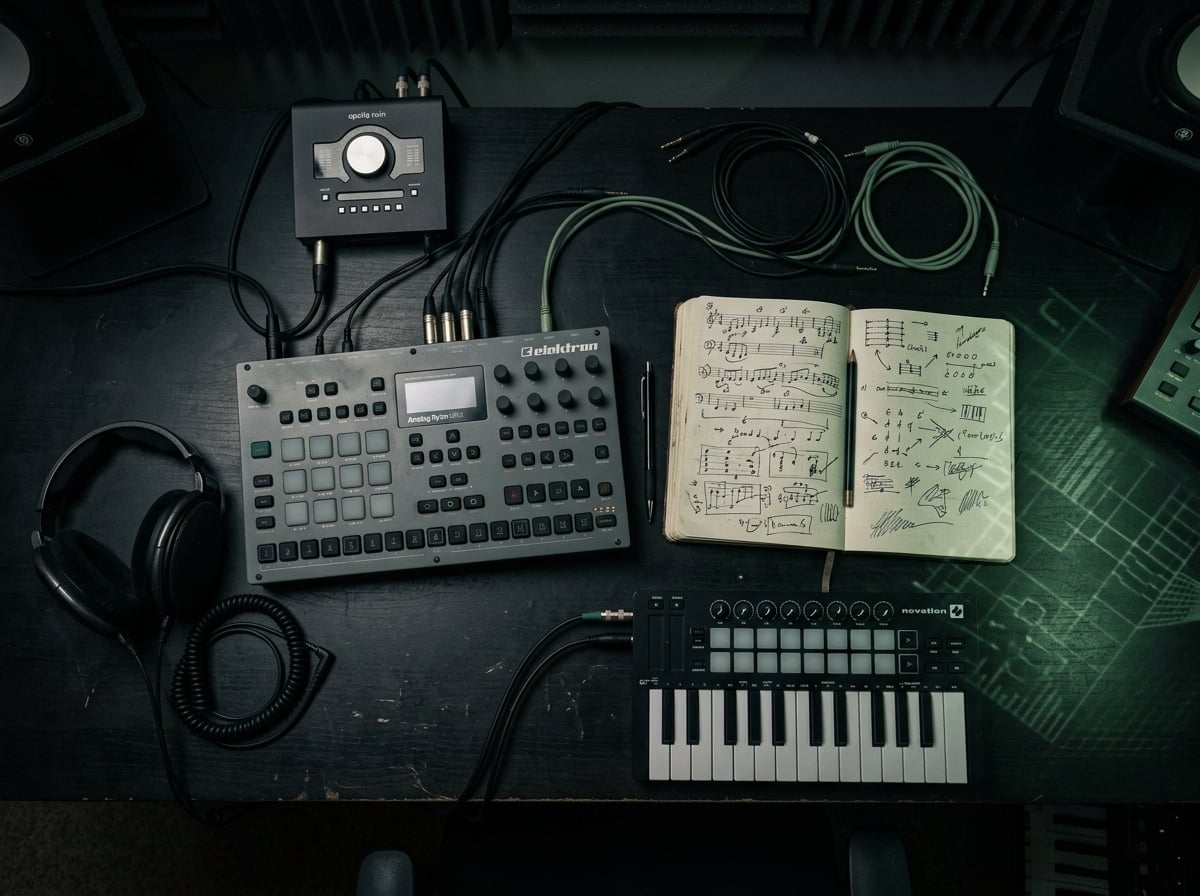
A kick can be generated. Identity cannot.
Transparency is the minimum standard
If there is one thing every side of this debate can agree on, it is that people should know what they are listening to. Spotify's answer is to move away from a blunt AI versus not AI label and towards granular disclosure. Working with DDEX, the platform is supporting a standard where creators can declare exactly where AI was used, in vocals, instrumentation, or post production, with that information surfaced in song credits (Spotify Newsroom).
Recommended watch
A Spotify executive explains the platform's approach to AI music, fraud enforcement and artist royalties.
Two details matter for artists. First, Spotify has said that disclosing AI use is informational and is not meant to trigger penalties or downranking on its own. Second, disclosure is separate from enforcement: the spam and fraud filters analyse behaviour and audio, not just the label a distributor attached (ABC News, 16 July 2026). In other words, being honest about using AI is not what gets you removed. Spamming, faking streams or impersonating someone is.
Transparency also covers the oldest question in this scene: who actually made and controlled the release? That is the same accountability we asked for around ghost production, and the same clarity we mapped out when explaining the real difference between a feature, a collaboration and a remix in Feat, collab, remix. Credit is not bureaucracy. It is how a scene keeps trust.
A practical framework for artists using AI responsibly
This is not legal advice, and platform rules change. For anything involving rights or permissions, check the current terms of your distributor, platform and relevant licences. With that said, here is the working checklist we would give any producer on the roster who wants to use AI without compromising their identity or their payouts.
- Keep the human brief and the final call. You define the intent and you sign off. The tool serves the vision, not the other way around.
- Never clone a voice or imitate a living artist without permission. Unauthorised vocal impersonation is explicitly targeted by platform policy.
- Check licences, ownership and platform rules for any AI tool you use, so you actually hold the rights to what you release.
- Do not mass upload filler. Ten thousand disposable tracks is a spam signal, not a catalogue.
- Never buy or manipulate streams. This is the single fastest way to get removed and demonetised, AI or not.
- Disclose where AI use is material to the release. Honesty is not penalised. Concealment erodes trust.
- Preserve session files, stems, credits and documentation. If your authorship is ever questioned, proof is your best defence.
- Reinvest the time you save into composition, sound design, mixing, performance and your community, the things a model cannot do for you.
If you want the wider career context around demos, ownership and how to present real work to a label, we wrote a full guide on how to send music to a record label.
Conclusion
The 75 million number is not the end of AI music. It is the start of the industry drawing a line, badly reported but broadly sensible, between tools and fraud. For independent artists in the hard scene, that line is an opportunity. A cleaner ecosystem, honest disclosure and real enforcement against spam and manipulation all favour the producer who actually has something to say.
The future should not be framed as human versus machine. It should be human creativity using technology with purpose. Use the tools. Keep the authorship. Protect the identity. That is not nostalgia, it is strategy, and it is the only version of this future where the artist still wins.
Join the conversation
Where do you draw the line between using AI and losing your identity? Drop your take in the comments below. And if you are an artist with a genuine sound and a real point of view, this is exactly the kind of work we are looking for.
Frequently asked questions
Is Spotify banning all AI generated music?
No. Spotify has not banned AI made music as a category. Its removals target spam, duplicates, artificial streaming and impersonation, and it has introduced disclosure and anti spam measures rather than a blanket ban (Spotify Newsroom).
Why is Spotify removing spammy tracks?
To protect listeners and legitimate artists from mass uploaded, duplicate and manipulative content, and to defend royalty pools from artificial streaming. Spotify reported removing more than 75 million such tracks in a year (Music Business Worldwide).
Can artists use AI in music production?
Yes. Using AI as a tool inside a human creative workflow is permitted. The issues arise with unauthorised voice cloning, deceptive identities, mass upload spam and stream manipulation. Always check the current terms of your distributor, platform and licences.
What is the difference between AI assisted and AI generated music?
AI assisted music is created by a human artist who uses AI for parts of the process while retaining authorship and final decisions. Fully AI generated music is produced end to end by a system with little or no human creative direction. Spotify is moving towards granular disclosure so listeners can see where AI was used (ABC News).
Can AI music affect streaming royalties?
Indirectly, yes. A single legitimate stream does not steal from another artist, but bulk manipulative uploads and streaming fraud distort discovery and dilute shared royalty pools. Deezer reported that up to 85% of streams on fully AI generated tracks were fraudulent and demonetised (Deezer Newsroom).
Sources and further reading
- Spotify Newsroom, Spotify strengthens its AI protections for artists and songwriters, 25 September 2025.
- ABC News, Spotify is making AI music easier to detect, 16 July 2026.
- Music Business Worldwide, Spotify has deleted 75m spammy tracks as it unveils new AI music policies, September 2025.
- Variety, Spotify unveils new AI safeguards for artists, 25 September 2025.
- The Hollywood Reporter, Spotify announces new AI policies and spam filter enforcement, September 2025.
- Music Business Worldwide, AI music app Boomy: Spotify deletes uploads after detecting stream manipulation, May 2023.
- Forbes, Spotify removes tens of thousands of AI generated songs, here is why, 9 May 2023.
- Spotify for Artists, Track monetization eligibility, 2024.
- Music Business Worldwide, Spotify confirms tracks will need 1,000 plays to generate royalties, 2023.
- TechCrunch, Deezer says more than 50% of daily uploads are AI generated, 21 July 2026.
- Deezer Newsroom, AI generated tracks represent 44% of new uploaded music, April 2026.
- The Guardian, An AI generated band got 1m plays on Spotify, now insiders say listeners should be warned, 14 July 2025.
Editorial note: the position that AI should serve human creativity rather than replace it is the editorial view of Magistrates Music. Factual claims about platform policies and figures are sourced above. This article is not legal advice; always check the current terms of your distributor, platform and relevant licences.