

The Festival Collapse: Why Defqon.1 2026 Marks the End of the Summer Bubble
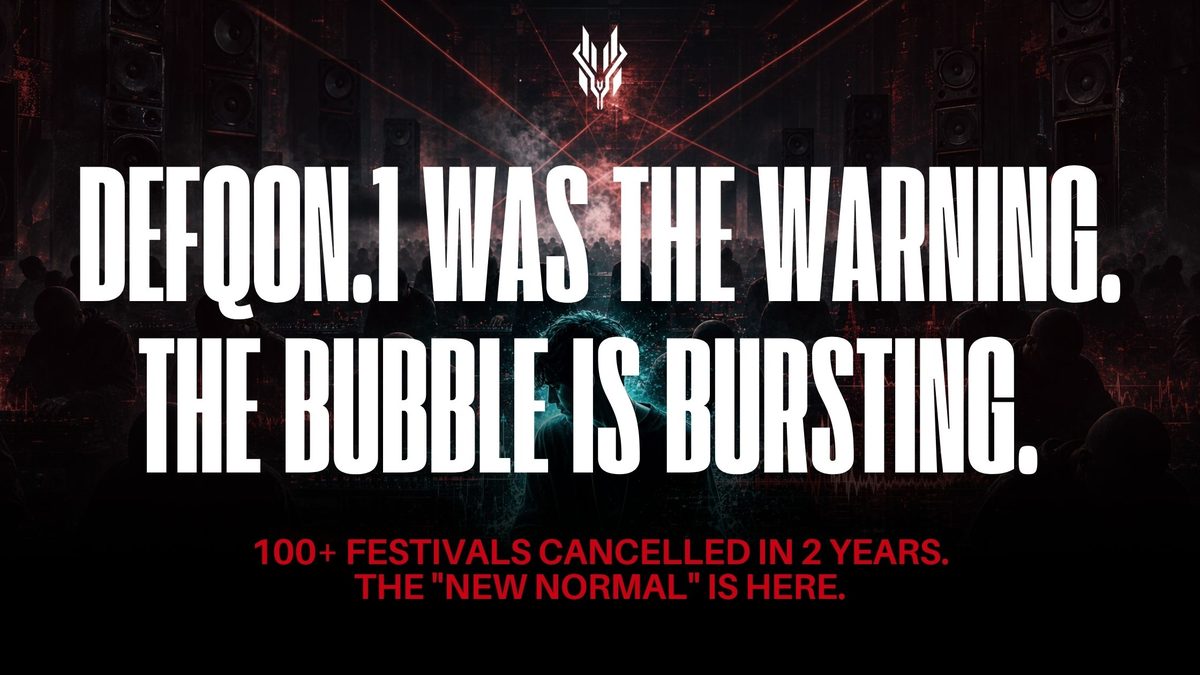
On June 26, 2026, Defqon.1 — the world's largest Hard Dance festival — was fully cancelled after the Netherlands issued its first-ever Code Red heat warning. But this is not just a weather story. It is the clearest symptom yet of an industry stretched to its breaking point.
We are witnessing the bursting of what many are calling the Great Festival Bubble: a market correction that is forcing promoters, artists, and labels to rethink the future of live entertainment. Over 100 festivals have disappeared across Europe in two years. The "summer festival" model — once considered unstoppable — is cracking under the weight of climate risk, economic pressure, and audience fatigue.
I. The Day the Music Stopped
Defqon.1 2026 opened on Wednesday, June 25, in Biddinghuizen with tens of thousands of attendees already on site. But as a historic heatwave swept across Western Europe, the Royal Netherlands Meteorological Institute (KNMI) issued the country's first-ever Code Red heat warning, forecasting temperatures of 40°C (104°F).
Organizer Q-dance attempted to save the event — restricting entry to weekend pass holders, cancelling high-exertion activities like the "Warrior Workout," and reducing capacity. But the Code Red classification carries legal weight: it signals conditions that endanger public health, emergency services, and large-scale outdoor events. The remaining weekend programming was fully cancelled.
Camping grounds stayed open through Friday so "Weekend Warriors" could safely arrange travel home. Full ticket refunds were confirmed by Q-dance, with further compensation details pending.
But Defqon.1 is not an isolated case. It is the loudest signal in a pattern that has been building for years.
II. The 3 Pillars of the Collapse
1. The Climate Crisis and Financial Liability
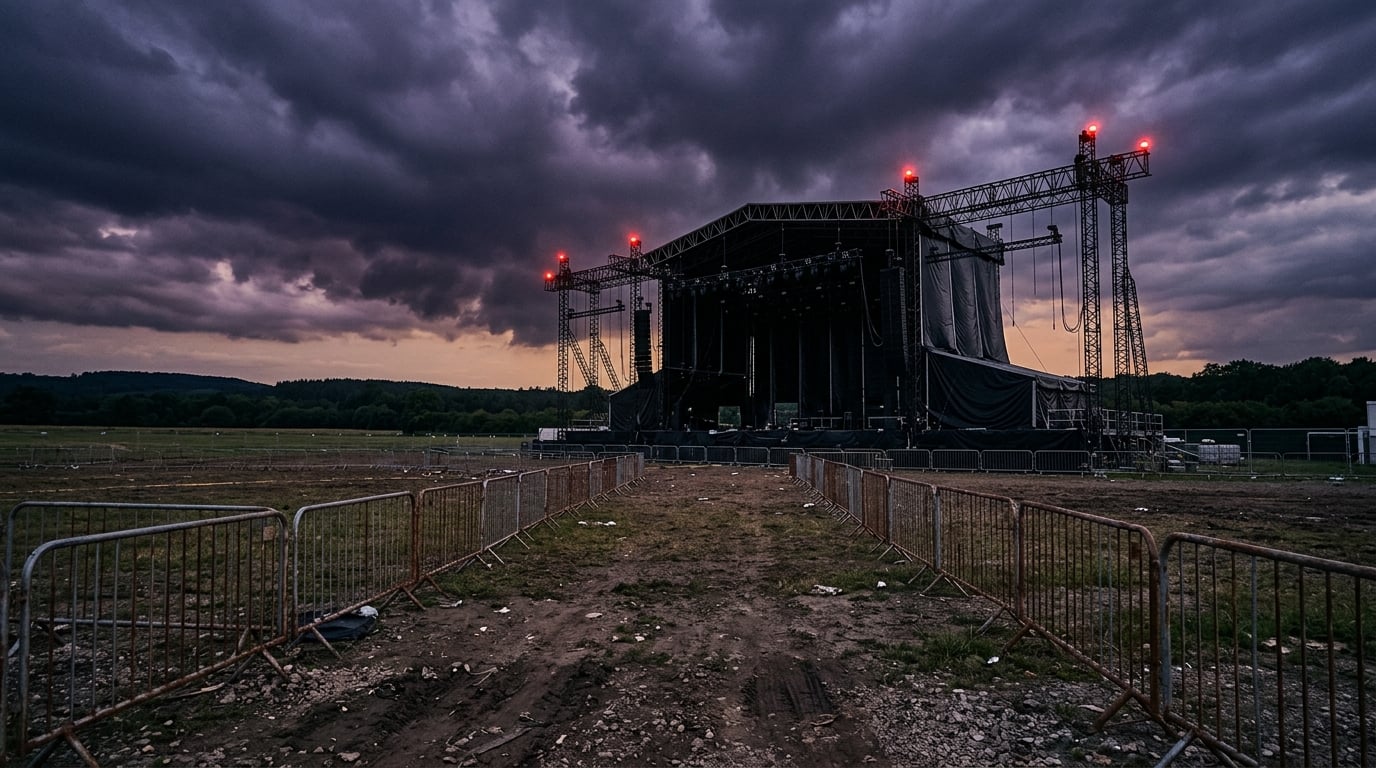
Hosting an outdoor festival in July or August has become a high-stakes financial gamble. A Code Red doesn't just cancel sets — it destroys entire economies built around a single weekend. With production and insurance costs skyrocketing by up to 250% since 2019, a single weather-related cancellation can bankrupt an independent promoter.
Climate volatility is no longer a "black swan" event — it is a structural risk baked into every outdoor festival budget. Extreme heat, flash floods, storms: the summer calendar that once seemed like a safe bet is now the most dangerous period to run a live event. Insurers are raising premiums, and in some cases refusing to cover heat-related cancellations entirely.
2. The "Saturation of Sameness"
The post-pandemic years triggered an explosion of new festivals. Promoters rushed to capitalize on pent-up demand, flooding the market with events that often felt interchangeable: same lineups rotating across identical weekends, same stage designs, same VIP upsell tactics, same Instagram aesthetic.
This oversaturation has led to what industry analysts call "festival fatigue": audiences are no longer willing to pay premium prices for uniformity. When every event looks and sounds the same, the magic disappears — and so does the willingness to spend €200+ on a weekend ticket.
We explored a related idea in Is the Scene Eating Itself? — when the music all sounds the same, identity collapses. The festival circuit is suffering from the exact same disease.
3. The Economic Squeeze: Cost of Living vs. Cost of Attending
The cost-of-living crisis has forced consumers to make harder choices. A family spending €500 on a festival weekend is competing with rent increases, energy bills, and grocery inflation. Meanwhile, mega-tours by global superstars (Taylor Swift, Beyoncé) have diverted massive portions of the live music budget away from multi-day festivals.
Add to that a generational shift: Gen Z spends differently. They prioritize guaranteed single-artist experiences over the uncertainty of a festival lineup. The result? Mid-sized festivals are being squeezed out of existence.
III. The Numbers Don't Lie: A Timeline of Collapse
The wave didn't start with Defqon.1. It has been building for two years:
2024–2025: The Silent Exodus
- ~60 festivals cancelled in the Netherlands alone in 2024, primarily events under 10,000 capacity (source)
- The UK lost 1 in 6 independent festivals during or after the pandemic, according to the Association of Independent Festivals
- Balaton Sound (Hungary), I Love Techno Europe (France), Elbjazz (Germany), Black Deer (UK) — all paused or cancelled in 2025
2026: The Breaking Point
- Mysteryland (Netherlands) — announced a "reset" year, plans to return in 2027
- Lollapalooza Paris (France) — cancelled for 2026
- Sonus Festival (Croatia) — confirmed cancelled
- Dreamstate Europe (Poland) — cancelled due to "circumstances beyond control"
- Wireless Festival, Live at Leeds, Hardwick Festival, Solfest, Highest Point (UK) — all gone for 2026
- Defqon.1 (Netherlands) — fully cancelled mid-event
And those are just the headlines. Dozens of smaller, local events have disappeared without press coverage. The full list keeps growing.
IV. The Indoor Migration: Hard Techno Wins
While outdoor festivals collapse, something else is growing. The audience is voting with their wallets — and they are choosing concrete over grass.
There is a massive shift toward indoor festivals, warehouse events, and club-format raves. Venues like Warehouse Elementenstraat (Amsterdam), Printworks (London, before its closure), Bootshaus (Cologne), and dozens of underground spaces across Berlin, Barcelona, and Madrid are thriving.
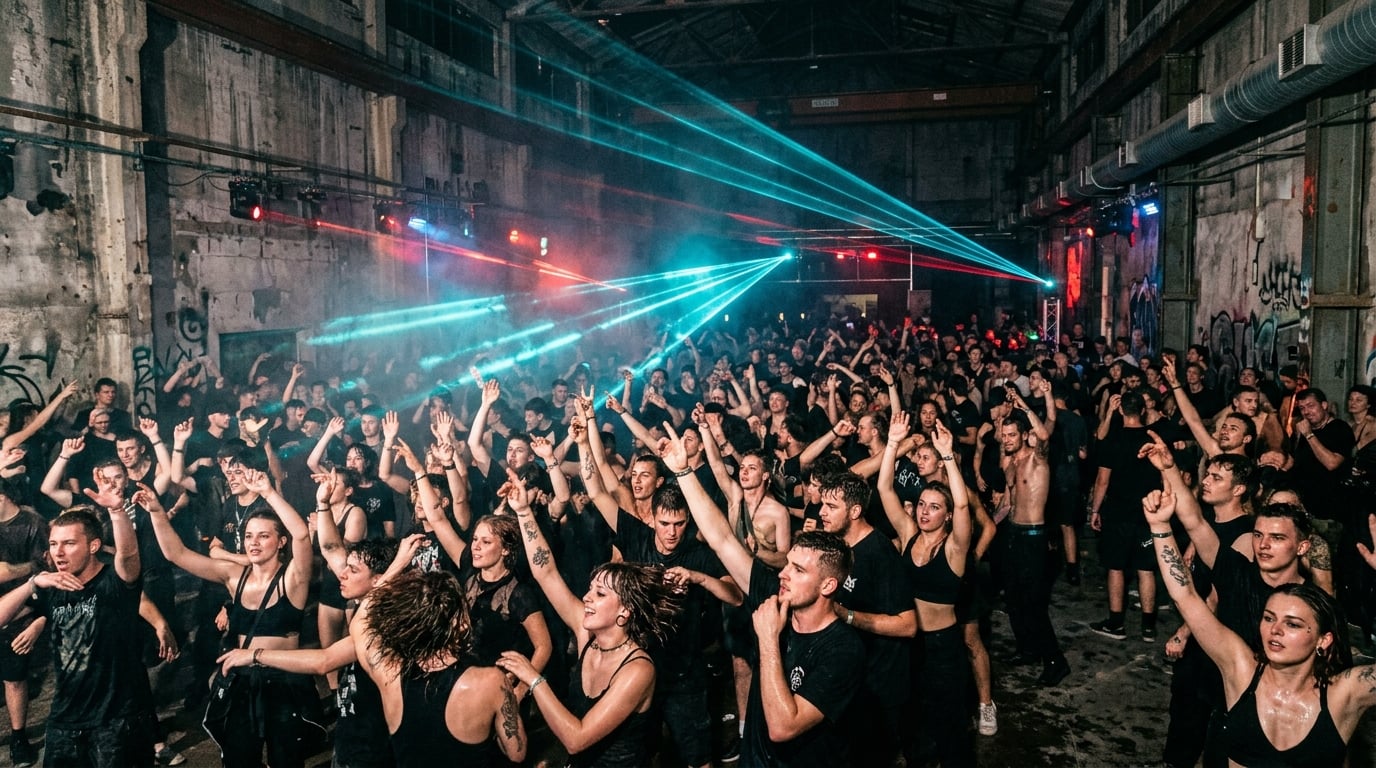
This is where Hard Techno, Industrial Hardcore, and genre-bending club music are winning. These styles don't need perfect summer sunshine — they thrive in darkness, in sweat, in controlled environments. No heatwaves. No cancellations. No €30 festival beers.
The indoor model also solves the economic equation: lower production costs, no weather insurance, year-round scheduling, and a more intimate audience experience that is harder to replicate or commoditize.
"The underground is no longer just a choice — it's a survival strategy."
V. What This Means for Magistrates Music
At Magistrates, we don't see this as an end. We see it as a necessary correction.
The future of electronic music isn't found in the size of the Mainstage. It's found in the identity of the sound. We are preparing for an era where artistic resilience and sonic authenticity outvalue pure marketing hype.
For our artists, this means focusing on music that dominates both Berlin warehouses and underground clubs in Madrid — without depending on massive summer infrastructures that can evaporate overnight. Our catalog reflects this philosophy: records built for impact, not for festival promo cycles.
The labels and artists who survive the next five years will be the ones who didn't need a Mainstage to prove their value. They will be the ones who built real identity when everyone else was chasing the same booking.
VI. Adapt or Disappear
The bursting of the festival bubble is an opportunity to clear the scene of empty promises. The industry is returning to its roots: control, safety, and community over quick profit.
What should artists and promoters take from this?
- Diversify your revenue: If your entire income depends on summer festival bookings, you are one Code Red away from zero. Build year-round streams — releases, merch, club residencies, brand work.
- Embrace the indoor circuit: Warehouse and club events are growing. Position yourself where the audience is going, not where it was.
- Right-size, don't supersize: A well-curated 2,000-person event with a loyal community will outlast a 40,000-capacity clone that can't fill its fields.
- Build real community: Festivals that survive will be those with year-round engagement, not one-off ticket sales.
The AIF (Association of Independent Festivals) has launched the "Five Percent for Festivals" campaign, calling for a temporary VAT reduction on ticket sales from 20% to 5%. But policy alone won't fix a structural problem. The model itself needs to evolve.
VII. Conclusion: The New Normal
Defqon.1 was the warning. But the bubble had already been deflating for years. What we are witnessing now is the acceleration phase — the moment where the industry stops pretending and starts adapting.
The festivals that survive will be smaller, smarter, more intentional, and weather-proof — either by moving indoors or by building such a unique experience that attendees choose them over everything else.
The music hasn't stopped. It has just moved underground. And for those of us who always preferred darkness over daylight, that might be exactly where it belongs.
"100+ festivals cancelled in 2 years. The 'new normal' is here — and it sounds harder than ever."
Are you a producer navigating the new landscape?
We are looking for artists who don't need a Mainstage to make an impact — identity-driven music for the underground.
Send Your DemoSources & Further Reading:
EDM.com — Defqon.1 Cancellation ·
DJ Mag — Defqon.1 ·
iMusician — Festival Decline ·
MusicFestivalWizard — 2026 Cancellations ·
CNN — Festival Industry Crisis ·
Five Percent for Festivals