
The death of the labels: why the gatekeeper model is dead and how to survive the 2026 Spotify algorithm
The traditional record label promised artists exposure, distribution and a career. In 2026, it delivers debt, creative restriction and a shrinking share of revenue that algorithms now hand out for free. The model is dead. What replaces it is what matters.
This is not a funeral sermon. It is a technical audit of why "gatekeeper" labels no longer make strategic sense for Hardcore, Uptempo and Hard Techno producers, why staying fully independent is equally risky, and why the only viable path forward runs through Spotify's algorithmic infrastructure and a new kind of partnership built around speed, data and artist ownership.
1. The gatekeeper model: how it worked and why it broke
For decades, the record label was the only serious pipeline between a producer and an audience. Labels controlled three things that an individual artist could not access alone: manufacturing (pressing vinyl or CDs), distribution (getting that product into stores worldwide) and promotion (radio pluggers, magazine ads, festival bookings).
In exchange, the artist signed over master ownership, typically received between 12% and 20% of net revenue, and was locked into multi-album deals that could last years. The arrangement was unequal, but it was functional: without a label, your music literally could not reach people.
That infrastructure collapsed in stages. Digital distribution killed manufacturing as a barrier. Streaming killed the retail chain. Social media killed the promotional monopoly. By 2024, services like DistroKid, TuneCore and Ditto could put any track on every major platform within 48 hours for a flat fee or a small revenue share, no gatekeeper required.

And yet many labels in the hard electronic scene still operate as if nothing changed. They still ask for master ownership. They still impose release schedules dictated by the label's calendar, not the algorithm's appetite. They still charge recoupable advances that keep artists in debt for years. If you want to understand how recoupment actually works in practice, we broke the full mechanics down in Where is your money?
The result is a growing disconnect. The label adds friction to the one thing Spotify rewards above all else: speed and consistency.
2. The myth of independence: why "just go solo" is not the answer either
If traditional labels are broken, the logical response is to go fully independent. And for some artists, it works. But independence is not free. It means you handle your own distribution, metadata accuracy, release scheduling, playlist pitching, marketing campaigns, social media content, accounting, tax compliance and legal disputes. That is a full-time operations job on top of actually producing music.
More importantly, independence does not solve the core problem: the algorithm does not care if you are signed or unsigned. It cares about engagement signals. And a solo artist releasing sporadically with no strategic framework will lose to a label-backed artist releasing every four weeks with metadata optimization, coordinated pre-save campaigns and data-driven audience targeting.
This is the trap the image on the cover describes. In 2026, both staying fully independent and signing to a gatekeeper label can be dead ends. The question is not "label or no label" but "what kind of partnership actually helps me feed the machine?"
3. The 2026 algorithm: what Spotify actually rewards
Before discussing what replaces the old label model, we need to understand the machine that now decides who gets heard. Spotify's recommendation engine in 2026 is not a single algorithm. It is a stack of interconnected machine learning systems: collaborative filtering (matching listeners by behavioral patterns), audio analysis (evaluating sonic characteristics like BPM, energy and key) and natural language processing (scanning web context about artists and tracks). According to Chartlex's 2026 algorithm guide, this stack weights engagement quality roughly 3x higher than raw stream counts.
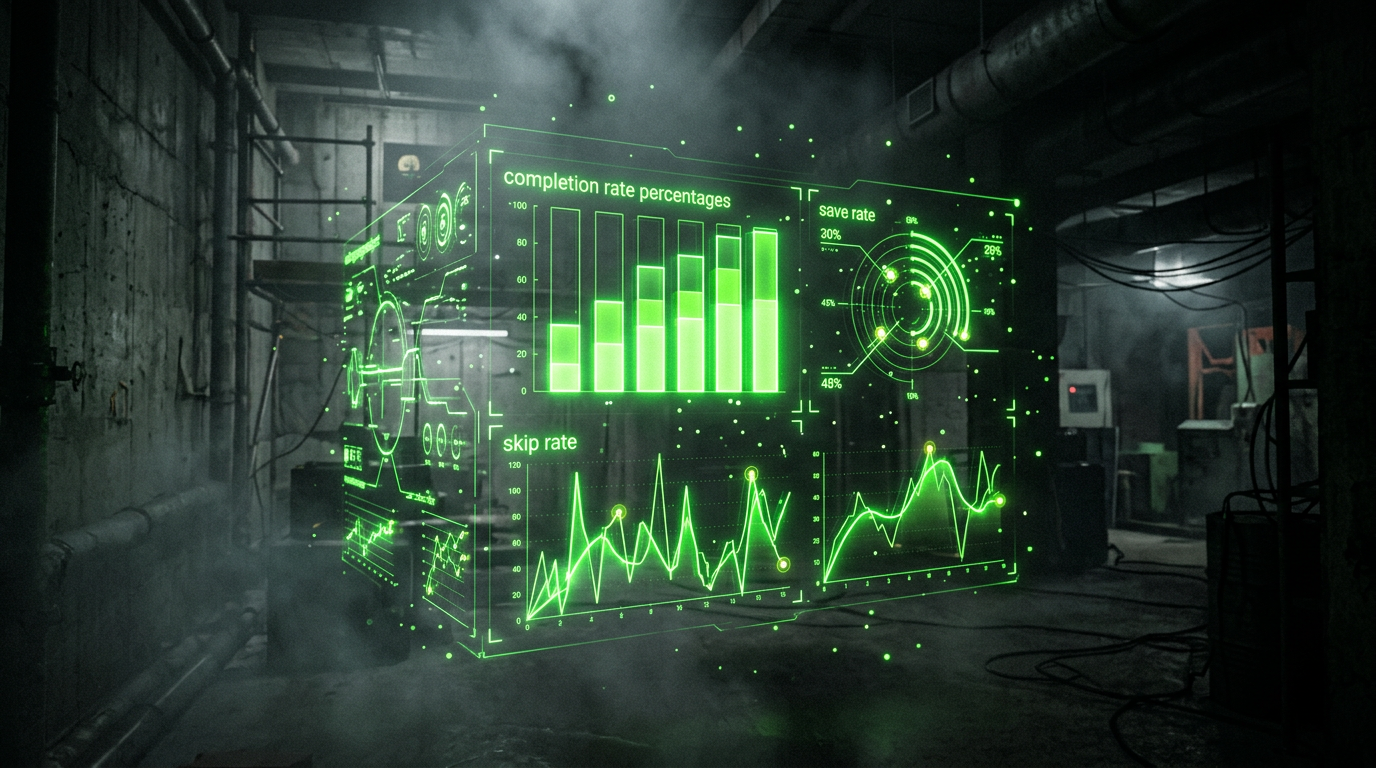
The critical engagement signals are:
- Save rate: The most influential positive signal. A save tells Spotify the listener actively wants to hear the track again. A save rate above 20% is considered the benchmark for triggering sustained algorithmic expansion into Discover Weekly and beyond (Chartlex, 2025 Playbook). Tracks that fail to maintain at least a 4.5% save rate typically lose algorithmic momentum within two to three weeks.
- Completion rate: A full playthrough is a stronger endorsement than a 30-second qualifying stream. Tracks with completion rates above 60% are far more likely to be placed into passive listening contexts like Radio and Autoplay.
- Skip rate: The primary "algorithm killer." Skips within the first 30 seconds are treated as failed recommendations, causing Spotify to throttle future distribution. A skip rate above 30% in that window effectively tanks a release.
- Repeat-listen ratio: A ratio of 2.5 or higher (meaning each listener plays the song multiple times) signals lasting appeal. This metric directly feeds placement in Radio and Autoplay.
What is notably absent from this list? Private playlist placement. Static third-party playlists, the thing many labels still sell as their primary value proposition, now generate diminishing returns. Listeners added through low-engagement playlists often skip early, producing the exact negative signals that suppress algorithmic reach. The era of "we will place you on our playlist with 50K followers" is over.
Key takeaway
Spotify in 2026 rewards depth of engagement, not breadth of exposure. One listener who saves, completes and replays your track is worth more to the algorithm than fifty passive streams from a playlist nobody curated.
4. Release Radar: the most reliable organic reach engine in 2026
If the algorithm is the machine, Release Radar is the ignition key. Release Radar is Spotify's personalized new-music playlist that updates every Friday for each individual user. It automatically includes new tracks from artists a listener already follows or has engaged with recently. According to The Metalverse's 2026 analysis, it functions as the initial testing ground: strong engagement here is the prerequisite for expanding into broader algorithmic playlists.

The mechanics are straightforward but unforgiving:
- Your track lands in Release Radar of your existing followers and recent listeners.
- The algorithm measures engagement during the first 48 to 72 hours: saves, completion rate, skip rate, repeat plays.
- If the engagement signals are strong, Spotify pushes the track into "test batches" for broader audiences via Discover Weekly, Radio and Autoplay.
- If signals are weak, the track is deprioritized and the expansion window closes within days.
This is why follower count is not a vanity metric. Every real follower is a guaranteed slot in Release Radar. And every save from a Release Radar listen compounds the algorithmic signal. The first 72 hours post-release are the highest-leverage window an artist has.
For hard electronic artists specifically, this creates a clear tactical priority: your pre-save campaign and your day-one community activation are your most valuable marketing actions. Not a playlist placement two weeks after release. Not a social media ad running a month later. The window is small and binary.
5. The waterfall strategy: frequency as a competitive weapon
The algorithm does not just evaluate individual tracks. It evaluates artist activity. Spotify's recommendation engine responds to consistent release patterns because frequent releases provide it with fresh data points, recurring Release Radar triggers and repeated opportunities to expand an artist's reach.

The waterfall release strategy exploits this behavior systematically. Instead of dropping an EP all at once and hoping for a spike, you release singles sequentially, every four to six weeks, with each new release stacking the previous tracks. Single 2 includes Single 1 as a B-side. Single 3 includes both. By the time the full project is compiled, every track has had its own Release Radar moment, its own 72-hour engagement window and its own algorithmic evaluation.
The strategic advantages are significant:
- Algorithmic compounding: Because stacked tracks carry over their stream counts, the overall performance of the project appears stronger to Spotify with each release, feeding a positive loop.
- Multiple pitch opportunities: Spotify allows artists to pitch one track per release for editorial consideration. A four-track EP as a waterfall gives you four pitch opportunities instead of one.
- Sustained audience engagement: Instead of one week of hype followed by silence, you maintain a content engine that runs for three to four months with constant news to share across social channels.
For the hard scene specifically, where production cycles can be fast and the audience expects a steady flow of new kicks and new energy, the waterfall cadence aligns perfectly with how the community already consumes music. The problem is that many traditional labels cannot move this fast. Their internal processes, approval chains and scheduling conflicts create bottlenecks that break the cadence the algorithm demands.
YouTube: The waterfall release strategy explained
6. The 20% save rate trigger: what makes Discover Weekly expand
Discover Weekly is the holy grail of algorithmic reach. Unlike Release Radar (which targets existing followers), Discover Weekly introduces your music to entirely new listeners based on behavioral matching. You cannot pitch for it. You cannot buy your way in. It is earned by demonstrating strong engagement from listener cohorts that overlap with the new audience Spotify wants to test you on.
The key threshold, documented consistently across multiple industry sources, is the 20% save rate from cold listeners. When listeners who have never heard you before save your track at that rate, it tells Spotify's collaborative filtering engine that the music has durable appeal beyond your existing fanbase. According to Chartlex's algorithmic playlist playbook, this is the primary trigger for sustained Discover Weekly expansion.
What does hitting 20% actually require in practice?
- Strong first impression: Your track needs to hook the listener within seconds. For Hardcore and Uptempo, this means the opening kick pattern, atmosphere and energy must immediately communicate what the track is. Long ambient intros are algorithmically dangerous because they create the exact skip behavior that tanks your metrics.
- Audience precision: The listeners arriving via pre-save links, social media and direct search need to be people who genuinely want to hear Hardcore, Uptempo or Hard Techno. If you drive general dance music fans to a 190 BPM track, you will get skips, not saves. We covered the damage fake or mismatched audiences can do in The Spotify Fake Check.
- Explicit call to action: The data is clear: asking fans to save a track, directly and specifically, measurably increases save rates. This is not optional. Include it in every pre-save campaign, every Instagram story, every email.
The 20% threshold is not a one-time achievement. It is the standard you need to hit consistently, release after release, to build compounding algorithmic momentum. This is where the waterfall strategy and a reliable release partner become essential: you need the infrastructure to maintain quality and cadence simultaneously.
7. Gatekeeper vs. service label: the real choice in 2026
With the algorithmic landscape now defined, the question of what replaces the traditional label becomes clear. The answer is not "no label." It is a different kind of label: one that operates as a service engine rather than a gatekeeper.
The distinction is structural:
| Factor | Gatekeeper label | Service label |
|---|---|---|
| Master ownership | Label owns masters | Artist retains masters |
| Revenue split | 80/20 to 70/30 (label/artist) | 50/50 or better (artist/label) |
| Release schedule | Label controls timing | Artist-driven, algorithm-optimized |
| Creative control | Label approval required | Full artist autonomy |
| Primary value | Playlist access, brand prestige | Speed, data, infrastructure, cadence |
| Contract duration | Multi-year exclusive deals | Per-release or short-term |
A service label does not promise you access to a "secret playlist." It provides the operational infrastructure that lets you execute the strategies described in this article at the speed the algorithm demands. That means fast turnaround from master delivery to distribution, pre-save page generation, metadata optimization, coordinated social media assets, SoundCloud pre-release campaigns and strategic release timing, all without taking ownership of your work.
If you are evaluating whether a label partnership makes sense for your career right now, start with the framework we outlined in Artist vs. Artist-Product. That article breaks down when collaboration creates value and when it creates dependency.
8. The Magistrates philosophy: engine, not gatekeeper
This article is not neutral and we are not pretending it is. Magistrates Music was built specifically around the model described here. We operate as a service label because we believe the gatekeeper model is structurally incompatible with how the streaming economy works in 2026.
In practice, that means:
- Artists retain their masters. Every release on Magistrates belongs to the artist. We license, we do not own.
- Release cadence is algorithm-first. We operate on a two-releases-per-week schedule across the roster because the algorithm rewards consistent label activity, not just individual artist output.
- Pre-save infrastructure is standard. Every release gets a dedicated pre-save page, coordinated social assets and a SoundCloud early free download to maximize day-one engagement signals.
- Everything is coordinated with the artist. Every decision, every release plan, every strategy is built together with the artist, never imposed unilaterally. This is a partnership, not a chain of command.
- Data is shared openly. Artists have full access to their streaming analytics and, just as importantly, a clear and concise view of exactly how much money their music generates and when. No black boxes, no vague statements.
- 100% of royalties go to the artist. We do not put artists in debt with recoupable advances. The artist keeps 100% of their royalties; we only retain a small recoupment that is reinvested directly into infrastructure, better tools and better services, so the artist can extract the maximum from every release.
- We are the only label that pays royalties monthly — and your money never even passes through us. Payments are not quarterly or annual. They are monthly. And the royalties do not sit in a Magistrates account at any point: there is a direct distribution channel that routes your money straight from the distribution and collection process to you, without us ever handling it. You are never waiting on the label to release your own earnings.
This is not charity. It is a strategic alignment of incentives. When the artist's track performs well algorithmically, both the artist and the label benefit. There is no scenario where the label profits from holding an artist back, slowing a release or restricting creative decisions. The only thing that matters is engagement quality, and the only way to get that is to give artists the tools and the speed to stay relevant.
If you are a Hardcore, Uptempo, Frenchcore or Hard Techno producer exploring whether a label partnership makes sense, we built a practical guide for that exact decision: How to send music to a record label.
9. The practical playbook: what to do this week
Theory is worthless without action. Here is a concrete checklist you can start executing today, whether you work with a label or release independently:
Your algorithmic survival checklist
- Audit your release frequency. If you have not released a track in the last 8 weeks, the algorithm has likely deprioritized your profile. Plan your next three releases now with four to six week spacing.
- Check your save rate. Open Spotify for Artists, go to your last three releases and calculate saves divided by streams. If you are below 10%, your audience targeting needs work.
- Optimize the first 30 seconds. Listen to your upcoming release critically. Does it communicate its energy within 10 seconds? If there is a slow build before the hook, consider restructuring. The algorithm penalizes early skips.
- Build your pre-save funnel. Every release needs a pre-save link distributed at least one week before drop day. Push it to your email list, Instagram stories, WhatsApp groups and Discord servers.
- Ask for the save. Explicitly. In every social post, every story, every DM to fans. "Save the track on Spotify" is the single most valuable call to action you can make.
- Stop chasing playlists. If your primary strategy is getting placed on third-party playlists with large but disengaged followings, redirect that energy to building your own follower base and optimizing for Release Radar performance.
- Use SoundCloud strategically. An early free download one week before the Spotify release activates your core fanbase, builds anticipation and creates the social proof that drives day-one saves.
Sources
- Chartlex (2026). How the Spotify Algorithm Works in 2026: Complete Guide
- Chartlex (2025). How to Get on Spotify's Algorithmic Playlists: The Ultimate Growth Playbook
- The Metalverse (2026). Spotify Algorithm 2026
- Artistrack (2026). Spotify Waterfall Release Strategy 2026
- iMusician (2026). Waterfall Release Strategy
- Orphiq (2026). Music Industry 2026 Trends
- Music Pulse (2026). How the Spotify Algorithm Really Works in 2026